
How Shipping Works
Origins, zones, rate types and the exact order the shop resolves them in.
Three things decide what a shopper is charged, and they resolve in this order. Understanding the order is most of understanding shipping.
1. Where It Ships From
Settings, Shipping, Origins. The address a parcel leaves from. Carriers quote distance from it, so an approximate address gives approximate prices.
A shop can have several origins. A product can be tied to one, which is how a second warehouse, a drop-shipper or another country works. When a basket contains products from different origins, the shop quotes each group separately and the customer sees the combined cost.
2. Which Zone the Shopper Falls Into
Settings, Shipping, Zones. A zone is a group of countries, optionally narrowed to regions or postcodes within them.
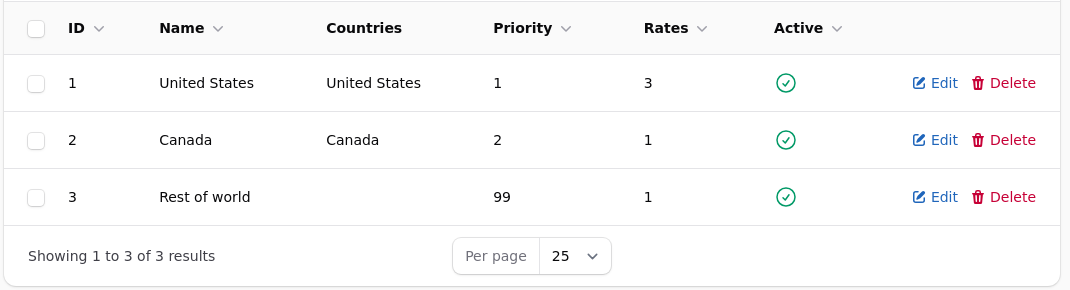
Order matters more than anything else here
Zones are checked in priority order, lowest number first, and the first one that matches wins. Give your catch-all a high number. Give it a low one and it swallows every shopper before your specific zones are looked at.
A zone with no countries means every country. That is how a catch-all is made.
A zone narrowed by postcode is how you charge differently for a remote area, or exclude one entirely.
3. Which Rates That Zone Offers
A rate is one line in the shopper's list of choices. Every rate in the matching zone is offered and the shopper picks.
| Rate type | What it does |
|---|---|
| Flat rate | One price, whatever is in the basket |
| Free shipping | No charge, usually above a threshold |
| Local pickup | No carriage, collected in person |
| Weight table | Price bands by total basket weight |
| Price table | Price bands by basket value |
| Live carrier rate | Asks the carrier for a real quote |
Each rate can carry a minimum order amount, which is how "free over $75" is built: a free rate that only appears once the basket qualifies. A rate can also be limited by minimum and maximum weight, which is how an oversized parcel is pushed onto a different service.
If nothing matches, the shopper is told you do not ship there. That is better than a silent zero.
Live Carrier Rates
Settings, Shipping, Carriers. Connect USPS, UPS, FedEx, Canada Post, Australia Post or DHL and the shop asks them for a price at checkout instead of using your own table. More accurate, slower, and entirely dependent on your weights.
Live rates are only as good as your product weights
A product with no weight is treated as weightless. A quote is calculated for the whole basket, so one wrong weight produces a wrong price for every basket that product lands in, including baskets full of correctly weighed items. When a shipping price looks absurd, the cause is rarely the item being looked at.
Carrier accounts also differ in what they return. A negotiated rate is only quoted if your account is configured to return one, otherwise you will see published retail prices and wonder why they are high.
Handling and Packaging
A handling fee can be added per rate, which recovers packaging costs without inflating the carriage line the customer compares against a carrier's published price.
Decide whether it applies per order or per parcel. A fee per order is simpler and is what most shops want.
Free Shipping, Properly
"Free over $75" is a free rate with a minimum order amount of 75. Two things to get right.
The minimum is checked against the goods, before shipping, which is not how a customer reads it. Say "on orders over $75" rather than "when you spend $75" if you want to avoid the question.
And a free rate sits alongside your paid ones rather than replacing them, so a qualifying shopper sees free and express. That is usually what you want, because some of them will pay for speed anyway.
Products That Do Not Ship
A product with requires shipping off is ignored by shipping entirely. A basket holding nothing else asks for no delivery address and offers no rates.
That is right for a download, a membership, a donation or a service. It is wrong for anything that goes in a parcel, and a physical product with the flag off will be sold with no carriage charged at all.
Several Origins in One Basket
When a basket holds products tied to different origins, the shop quotes each group separately and shows the combined cost. The customer may receive more than one parcel, and the delivery estimate is the slowest of them.
If that is going to happen often, say so on your delivery page. Customers who receive half an order and no explanation contact you about the other half.
What to Do When a Price Looks Wrong
Work through it in this order.
Check the weights of everything in the test basket, including the things you are not suspicious of. One wrong weight distorts the whole quote.
Check which zone matched. A shopper you expected in a specific zone may be falling into the catch-all because the catch-all has a lower priority number.
Check the origin address is complete, including postcode. Carriers quote from it and a vague origin produces vague prices.
Check the carrier account if you are using live rates. Published retail prices appearing where you expected negotiated ones is an account configuration matter at the carrier's end, not a shop setting.
Testing It
Put something in a basket and go to checkout as a shopper would, with a real destination address. Reading the rate table tells you what you configured. Checkout tells you what a customer is actually charged, which is the only number that matters.
Test at least four destinations: local, the far side of your own country, somewhere you ship to internationally, and somewhere you do not. The last one should tell the shopper you do not ship there rather than quoting zero.
Test a heavy basket and a single light item. Weight bands and carrier quotes both behave differently at the extremes, and a rate table that looks sensible for one book is often absurd for twenty.