
Customer Groups and Wholesale
Building trade pricing, restricting what a group sees, how the best price is chosen, and the traps in a blanket percentage.
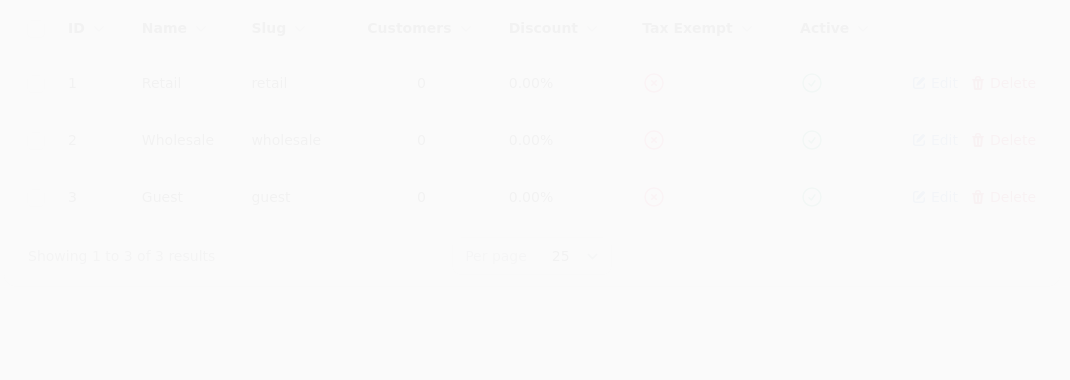
Customers, Customer Groups. A group does four separate things, and most shops only want one or two of them.
1. A Blanket Discount
Discount percent takes that percentage off everything for members of the group. That is the quickest way to set up trade pricing, and the one with the most ways to go wrong.
A blanket percentage applies to things you did not think about
Memberships, gift cards, donations, fundraiser lines and postage-recovery products are all "everything". Before switching one on, look at your catalogue and ask what should not be discounted, then exclude it.
Three ways to exclude something: tick exclude from group discounts on the product, tick it on a whole category, or set a specific price for the group, which overrides the percentage.
2. Specific Prices
A price can be set for a named group on the product's Pricing tab. That is the precise way to do trade pricing, and the right one when your discount is not a single percentage across the range.
A specific price always beats a blanket percentage, and the two never add together.
3. Visibility
A group can be restricted to named categories and products. That does two things at once: members see only those, and non-members cannot see them at all, including in search.
That is how a trade-only range works. It is also how a shop runs a members' section without a separate site.
Restricting a group restricts its members too
If you restrict a group to a wholesale category, its members lose the rest of your shop. That is right for a pure trade account and wrong for a customer who also buys retail from you. If you want both, leave the restriction off and use pricing alone.
4. Tax
A group can be marked tax exempt, which is how resellers and institutions that do not pay it are handled. The exemption applies to the whole order.
How the Best Price Is Chosen
A customer in several groups gets the single best price they are entitled to. Discounts never stack.
The order of precedence, highest priority first:
- A price set specifically for one of their groups
- The most generous blanket percentage among their groups
- The product's own price
A product excluded from group discounts skips step two entirely, but a specific price in step one still applies, because that was a deliberate decision rather than a blanket rule.
Setting Up Wholesale
A workable shape for most shops.
Create a Wholesale group with the percentage you actually offer. Exclude the categories that should stay at full price. Create the trade-only products or categories and restrict them to the group if you have any. Then add a payment method, usually purchase order, restricted to the same group.
Finally, place a test order as a member of the group and check the prices, the tax and the payment options are all what you intended. Group pricing is the area where a small mistake is invisible to you and obvious to the customer.
Putting People In
Either edit the customer and add the group, or edit the group and add customers. It takes effect immediately, including on a basket they already have open.
Signing up through a wholesale application form does not assign the group automatically unless you have set that up, so new applications need checking.
Seeing What a Customer Sees
The surest test is to look at the shop as a member of the group. Prices resolve when the page is read, so what you see signed in as a trade customer is exactly what they get.