
Coupons
Every field, how the discount is calculated, what restricting does, stacking, and how to tell whether a code worked.
Marketing, Coupons. A code the shopper types at checkout.
The Three Kinds
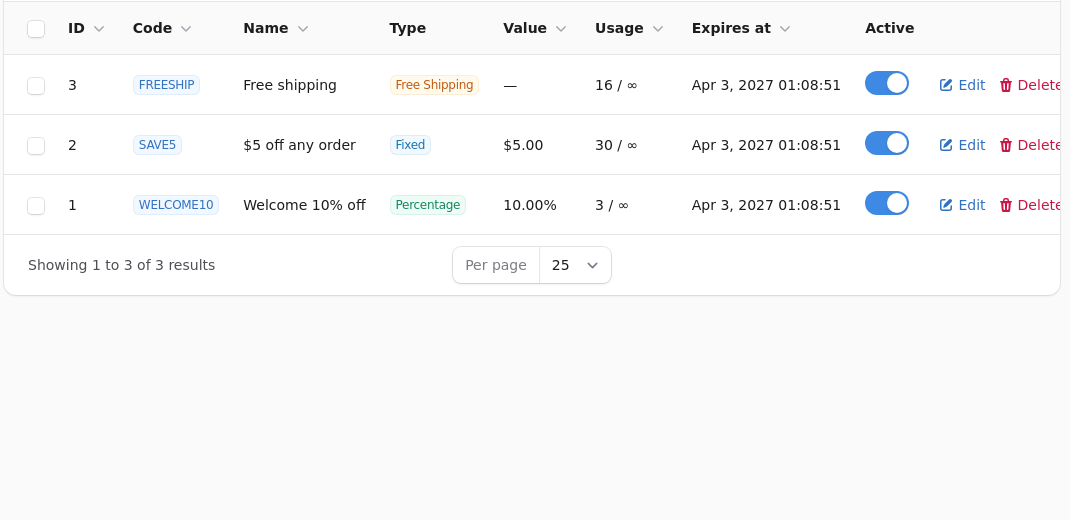
Percentage takes a percentage off. Fixed amount takes a set sum off and never takes the order below zero. Free shipping removes the carriage charge and leaves the goods at full price.
Restricting One
A coupon can be limited to particular products, categories or variants. This does two separate things, and the second is the one people miss.
It decides whether the code is accepted. A basket with nothing matching is turned away with a message.
It also decides what the discount comes off.
Restricting changes the sum, not just the answer
A code restricted to one category takes its percentage off the items in that category only, not off everything else in the basket. Name a category and a product together and both are covered. Test a code against a real basket before advertising it.
Restricting to a variant is how you discount one edition and not another: the paperback and not the hardback, the small and not the large.
Every Limit, and What It Is For
Usage limit caps total uses across the shop. This is how a genuine first-hundred offer is built, and it is the only thing standing between you and a code that gets posted to a deals site.
Usage limit per customer caps how often one person can use it. Without it, one shopper can use a code on every order they ever place. For a welcome offer, set this to one.
First purchase only restricts it to people who have never ordered. Note that this is checked against the account, so a returning customer ordering as a guest with a new email address will pass it.
Minimum order amount is checked against the goods, before shipping is added. A $50 minimum means $50 of products, not a $50 total.
Maximum discount amount caps what a percentage can take off. A 20% code with no cap costs you 20% of an unusually large trade order. Set a cap on any percentage you advertise publicly.
Dates
Starts at lets you prepare a campaign in advance. Expires at ends it.
A coupon with no end date runs forever
Codes outlive the campaigns they were made for. They get shared, posted, scraped and found again years later. Set an expiry even on a code you intend to run indefinitely, and extend it if you still want it running.
An expired code is refused with a message rather than silently ignored, so a customer who finds an old one is told why it did not work.
Combining Codes
By default a coupon cannot be combined with another. Mark one stackable and it can.
Be careful. Two stackable percentages both come off, and shoppers are efficient at discovering which combinations work. If several campaigns run at once, leave stacking off unless you have deliberately decided the combination is affordable.
What the Shopper Sees
The order summary names the code, and for a percentage says what the percentage was, so they can see that OCTOBER took 20% off rather than only that something came off.
A code that is refused gets a specific reason: not valid, expired, already used, minimum not reached, or nothing in the basket it applies to. That is deliberate, because a vague refusal generates an email to you.
Checking Whether It Worked
The Coupon Report shows uses and total discount given per code.
Read it with the Sales Report beside it. A code with many uses and a low average order value is one that got shared beyond its intended audience, or one that discounted people who would have bought anyway. A code with few uses and a high average order value is usually the better campaign even though it looks quieter.
Common Mistakes
A percentage with no maximum, applied to a trade order. A code with no expiry, still working a year later. A code restricted to a category that the products were never actually filed in, so it is refused for everybody. And a minimum order amount that the shopper reads as including delivery when it does not.
Gift Certificates Are Not Coupons
A gift certificate is money somebody paid for, carrying a balance that is spent down across orders. It lives under Marketing, Gift Certificates, has a code, an initial and a current balance, a recipient, an optional message and an expiry.
A coupon is a discount you are giving away. A gift certificate is a liability you have already been paid for. Do not use one to do the other's job: refunding somebody with a coupon costs you nothing on the books and will confuse your accounts.